Learn what a B2B business Opportunity is, how it differs from Offers, Leads and tenders, and explore practical examples.
By bizTOnet TeamAugust 13, 20264 min read
What Is a Business Opportunity?
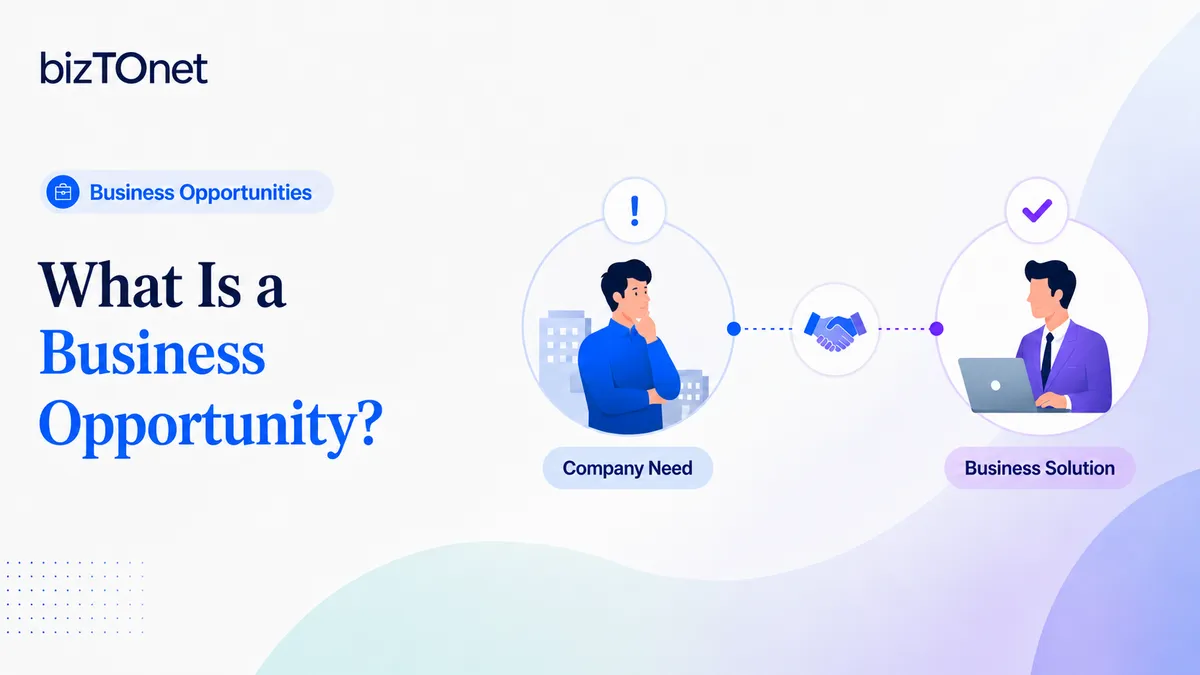
A business Opportunity is an explicit situation in which a company is looking for a Product, Service, supplier, provider, partner, investor or business solution.
It represents demand.
Examples:
A SaaS company needs a cybersecurity assessment.
An SME is looking for an accounting firm.
A manufacturer needs a new packaging supplier.
A company wants a distribution partner in Belgium.
A startup needs a marketing agency.
An investor is seeking acquisition targets.
What makes these Opportunities is not simply that business might happen.
The company has identified a need.
The four essential elements
A business Opportunity normally includes:
A company
A need
A type of solution or provider
A possible next commercial step
For example:
We are looking for a B2B marketing agency to launch our acquisition activity in France.
This is stronger than:
More articles
We want to grow in France.
The second describes an objective.
The first creates a business Opportunity.
Business Opportunity vs Offer
Offer
This is what we sell.
Opportunity
This is what we need.
Offer
Opportunity
Supply
Demand
Published by provider
Published by buyer
Describes solution
Describes need
Attracts clients
Attracts providers
A Marketplace becomes more useful when both sides are visible.
Business Opportunity vs Lead
A Lead is a potential commercial relationship.
An Opportunity is the need that may create that relationship.
Example:
Company publishes need for a CRM consultant.
Consultant responds.
Conversation begins.
Company becomes a potential Lead for the consultant.
Opportunity creates context.
Lead represents commercial potential.
Business Opportunity vs tender
A tender or RFP is generally more formal.
It may require:
specifications;
formal response format;
scoring criteria;
procurement rules;
fixed deadline.
An Opportunity can exist earlier.
The company may still be deciding:
what solution it needs;
which provider types exist;
what budget is realistic;
how to structure the project.
Not every B2B purchase needs a formal tender.
Business Opportunity vs job vacancy
A vacancy recruits an employee.
An Opportunity typically seeks an external commercial relationship.
Examples:
Hiring a Marketing Director = job vacancy.
Looking for a marketing agency = business Opportunity.
Ten common categories of business Opportunities
1. Professional Services
accountant;
lawyer;
consultant;
recruiter;
coach.
2. Marketing
branding agency;
SEO provider;
media agency;
content agency.
3. Technology
CRM;
cloud provider;
AI consultant;
cybersecurity provider.
4. Suppliers
materials;
equipment;
packaging;
office products.
5. Partnerships
commercial partners;
distributors;
resellers.
6. Investment
fundraising;
strategic investor;
financing.
7. International expansion
local representative;
distribution partner;
market-entry consultant.
8. Procurement
logistics;
cleaning;
training;
insurance.
9. Project collaboration
subcontractor;
specialist;
joint delivery partner.
10. Acquisition
buyer seeking businesses;
founder seeking succession.
25 practical examples
Looking for a B2B marketing agency
Seeking a CRM consultant
Looking for an accountant
Seeking GDPR support
Looking for a corporate lawyer
Searching for a cybersecurity audit
Looking for a web development agency
Seeking a branding company
Looking for a logistics supplier
Seeking office equipment
Looking for an AI governance consultant
Seeking a distributor in France
Looking for a reseller in Germany
Seeking an investor
Looking for acquisition financing
Searching for an executive coach
Looking for sales training
Seeking translation Services
Looking for an industrial supplier
Seeking sustainable packaging
Looking for a market-entry consultant
Seeking a recruitment agency
Looking for a strategic partner
Seeking subcontractors
Looking for a software implementation company
Why Opportunities matter for buyers
Publishing a need can:
generate inbound provider responses;
reveal unknown solutions;
reduce research time;
create comparison;
make demand visible.
Instead of searching provider by provider, the company can communicate the requirement once.
Why Opportunities matter for providers
Providers gain access to explicit business intent.
Before contacting the company, they may understand:
need;
context;
requirements;
timing.
This creates a stronger starting point than generic prospecting.
Business Opportunities create intent signals
A structured Opportunity reveals more than company characteristics.
It can show:
what;
why;
when;
requirements;
expected outcome.
This is particularly valuable in AI-assisted business matching.
Rather than inferring need purely from company data, an AI Agent may have access to an explicit demand signal.
FAQ
Is every need a business Opportunity?
A need becomes commercially actionable when another business or professional could reasonably respond to it.
Do Opportunities need budgets?
Not always, but budget context can improve response quality.
Can partnerships be Opportunities?
Yes.
Can independent professionals publish Opportunities?
When acting through their business and looking for external commercial providers or partners, yes.
The B2B demand side
Traditional directories show companies.
Marketplaces often show Offers.
Business Opportunities expose another layer:
What companies need.
bizTOnet brings both supply and demand into the same business Marketplace: